Quick answer: A nonverbal autistic child uses few or no spoken words to communicate. It is common and has no single cause. Many children do learn to speak later than expected. In one large study, 70% of autistic children who were not speaking in phrases at age 4 were using phrases by age 8, and 47% were speaking fluently.
You call your child’s name and they look up. You hold out a cup and they reach for it. They understand more every week, but the words still haven’t come. If that sounds like your home, this guide explains what nonverbal autism means, why it happens, and what helps a child find their voice, in words or in other ways.
What Is a Nonverbal Autistic Child?
“Nonverbal” is not a formal diagnosis. It is an everyday word for an autistic person who speaks very little or not at all. Researchers often say minimally verbal or nonspeaking, because many of these children say a few words or sounds.
Two things are true at the same time:
- Not speaking is not the same as not communicating. Children point, lead adults by the hand, use gestures, pictures or devices, and show what they want through behaviour.
- Not speaking is not the same as not understanding. Some nonverbal children understand a great deal of what they hear. Their receptive language (understanding) can be far ahead of their expressive language (speaking).
About 25% to 30% of autistic people have little functional speech, according to estimates cited by the Interactive Autism Network at Kennedy Krieger Institute.
What Causes Non Verbal Autism?
No one knows exactly why some autistic children don’t develop speech. Researchers point to several factors that often overlap:
- Autism itself. Autism affects social communication, the drive to share and copy sounds and words. At the same level of intellectual ability, an autistic child is more likely to remain minimally verbal than a child with intellectual disability alone.
- Speech-motor planning. Some children have trouble planning the mouth and tongue movements speech needs. Childhood apraxia of speech can occur alongside autism.
- How sounds are processed. Some children find it hard to make sense of spoken words, especially in noisy places.
- Brain connectivity. Studies have found differences in the brain networks used for speech production.
- Intellectual disability. It can occur with autism, but it is not the reason in every case. Some nonverbal children score well on nonverbal intelligence tests.
Nothing a parent did caused their child to be nonverbal.
Why Are Some Autistic People Non Verbal and Others Talk a Lot?
Autism is a spectrum. Two children with the same diagnosis can have very different language. One may speak in full sentences at two, another may use a few words at six. The mix of factors above is different for every child, which is why an individual assessment matters more than any label.
Can Nonverbal Autistic Children Learn to Speak?
Yes, many can, and later than many parents are told.
A 2013 study in Pediatrics followed 535 autistic children who had a severe language delay at age 4, meaning they were nonverbal or not yet combining words. By age 8:
- 70% were using phrase speech
- 47% were speaking fluently
Some children reached phrase speech at age 6 or older. The strongest predictors were higher nonverbal intelligence and fewer social difficulties. Repetitive behaviours and sensory interests did not predict who would speak.
Not every child will develop spoken language, and that is not a failure. A child who communicates well with a device, signs or pictures has a real voice.
At What Age Does an Autistic Child Speak Fluently?
There is no single age. Many autistic children who speak late reach phrases between ages 4 and 8, and some later. Progress usually comes in steps: sounds, single words, word pairs, then phrases.
Watch for the steps, not the calendar. A child who starts imitating sounds, pointing to share interest, or using pictures to ask for things is building the foundations of speech.
How to Support a Nonverbal Child at Home
- Get down to their level and follow what they are interested in.
- Pause and wait. Give your child several seconds to respond before you help.
- Model one or two words at a time: “ball,” “more ball.”
- Narrate routines like bath, snack and getting dressed using the same words each time.
- Offer choices, like “apple or banana?”, and hold both up.
- Celebrate every attempt, whether it is a sound, a sign, a picture or a word.
Does AAC Stop a Child From Talking?
No. It’s a common worry, but a research review by Millar, Light and Schlosser (2006) found that AAC (augmentative and alternative communication, such as picture systems or speech devices) did not stop speech from developing, and in some cases supported it.
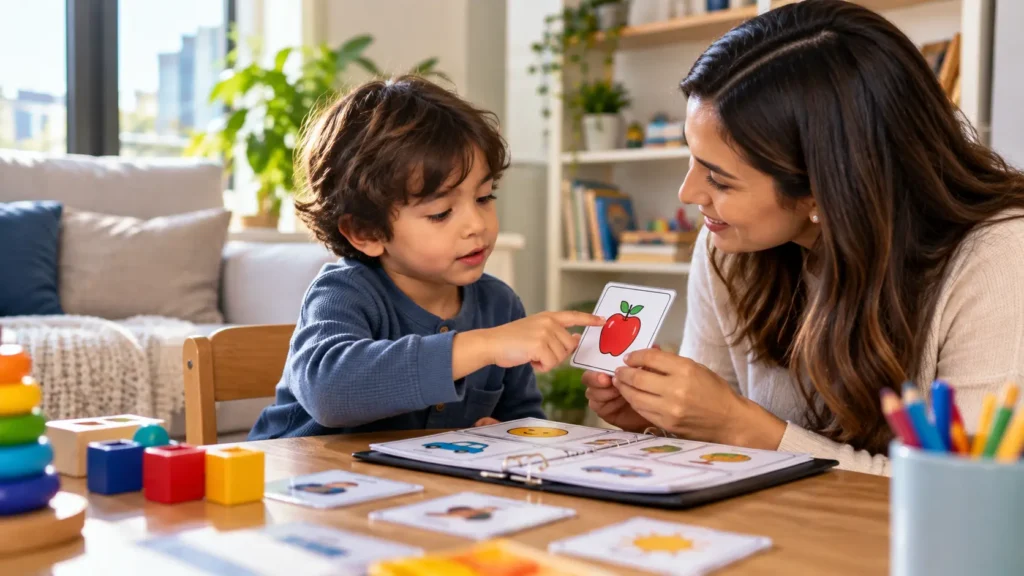
Picture exchange systems, sign and speech-generating apps give a child a way to communicate now, which can lower frustration while speech develops.
How ABA Therapy and Speech Therapy Help
ABA therapy teaches functional communication in small steps, using what motivates your child. A therapist may start with requesting a favourite toy using a picture, then a sound, then a word. Our article on how ABA therapy teaches communication explains this in more detail.
Speech-language pathologists assess speech, language and motor planning, and often lead AAC choices. Many children do best with both. Read ABA vs speech therapy to see how the two work together.
The younger the child, the more these supports can help. Early intervention ABA is designed for toddlers and preschoolers, and an autism assessment for children shows where to start.
Getting Support in Ontario
As a provider of ABA therapy in Canada, we build communication goals into every program, at home, at daycare or online. Families in Peel can start with in-home ABA therapy in Mississauga, and families across the city can learn about ABA therapy in Toronto.
If your child is younger and you’re still unsure whether it is autism or a speech delay, read 4 year old not talking but understands. If your child can talk but often won’t, see autism and not wanting to talk.
Frequently Asked Questions
Is nonverbal autism a separate diagnosis?
No. It describes how much an autistic person speaks. The diagnosis is autism spectrum disorder, sometimes noted with language impairment.
Can a nonverbal autistic child start talking at 5 or older?
Yes. In the 2013 Pediatrics study, some children first reached phrase speech at age 6 or later.
Does a nonverbal child understand what I say?
Often, yes. Many nonverbal children understand far more than they can say. An assessment can measure receptive language.
Will using a tablet or picture cards stop my child from speaking?
Research shows AAC does not prevent speech, and it may help.
When should I get help?
As soon as you are worried. You don’t need a diagnosis to start a speech or developmental assessment.
Talk to Our Team
Every child’s path to communication is different. Book a free consultation, and a Behaviour Analyst will help you understand your child’s communication and the next best step.