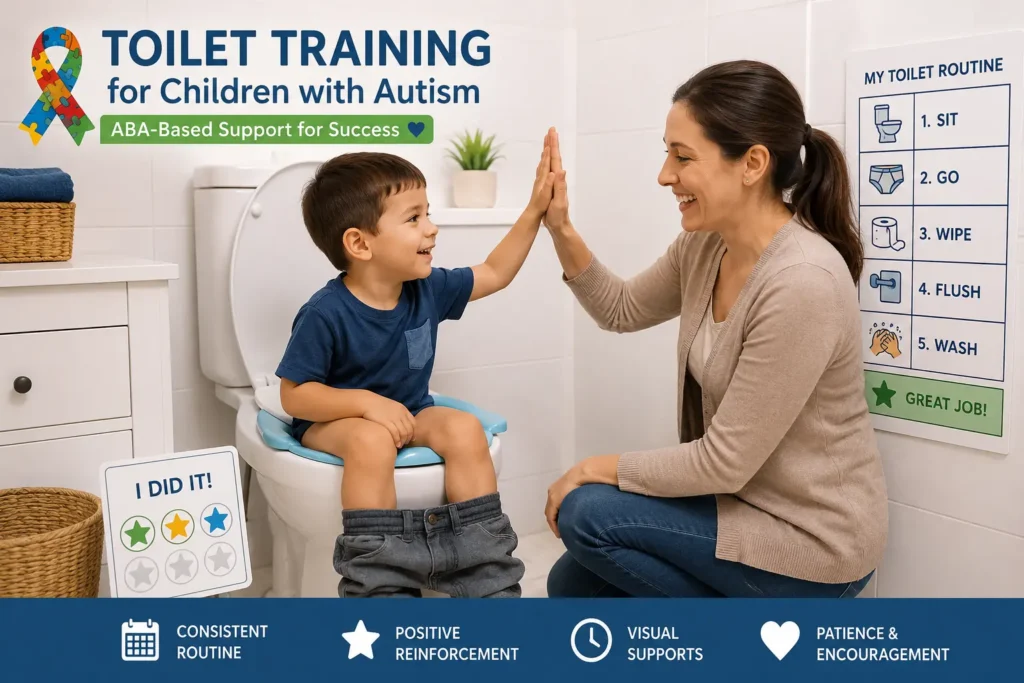
Quick answer: ABA toilet training works by increasing opportunities to succeed — more fluids, scheduled sits, and immediate reinforcement for going in the toilet — while tracking data to find your child’s natural pattern. Most children need consistent effort over weeks, not a single weekend.
The Log That Changed Everything
Aleena was five, and three different people had told her parents to wait until she was ready.
They had waited two years. She was still in pull-ups, still distressed at the bathroom door, and due to start school in September.
Before changing anything, I asked them to do one thing for two weeks: check her every thirty minutes and write down dry or wet. Nothing else. No pressure, no prompting, no rewards.
The log showed something nobody had noticed. Aleena voided roughly forty minutes after a drink, almost every time, with striking consistency.
She wasn’t unready. Nobody had been in the bathroom at minute forty.
(Aleena is a composite of several children; details changed to protect privacy.)
Why Toilet Training Is Different in Autism
Four factors make the standard advice fall short.
Interoception. Many autistic children have difficulty registering internal body signals — including a full bladder — until it is already too late.
Communication. A child who cannot yet request the bathroom cannot tell you they need it.
Sensory experience. Bathrooms are hard environments: echo, extractor fans, cold seats, the sensation of falling backwards into open water.
Routine. A child accustomed to eliminating in a pull-up while standing has a well-established habit. You are not just teaching a new skill, you are competing with an old one.
None of these mean waiting longer. They mean teaching differently.
Before You Start: Two Things That Are Not Optional
Get medical clearance. Constipation is extremely common in autistic children and it derails toilet training completely. A child who is impacted may have overflow leakage, painful bowel movements, and a learned fear of the toilet. Rule this out with your physician first — no behavioural programme will succeed around untreated constipation.
Take baseline data. Two weeks of thirty-minute dry/wet checks, before any intervention. This is the step families skip and clinicians never do. It tells you how often your child voids, how predictable the timing is, and whether they can stay dry for an hour or more — which is the practical readiness marker that matters far more than age.
Children’s assessments in Canada can formalise this stage, mapping communication level, sensory profile, and existing skills before a programme is built around them.
The ABA Method: Where It Comes From
Modern behavioural toilet training traces back to a 1971 protocol by Azrin and Foxx, known as Rapid Toilet Training. Its logic was simple and still holds: you cannot teach a skill that never gets practised, so you engineer more chances to practise it.
The original components were increased fluid intake, a dense schedule of toilet sits, immediate positive reinforcement for success, and a signalling device for accidents.
Fifty years of replication have refined it considerably.
What the research now suggests:
A systematic review of rapid toilet training intensity found the approach typically requires roughly thirty-minute intervals between sits, six days a week, totalling around 373 hours to produce the effect. That number is worth sitting with. Anyone promising toilet training in a weekend is selling something.
An outpatient study of thirty clinical records using a modified protocol found most children achieved full continence in an average of about two weeks of intensive work.
And a parent-delivered version produced daytime dryness within one to two days for two autistic boys, with independent toileting inside five to ten days — skills still intact three years later.
Start With the Least Intrusive Version
This is the most important update to the classic protocol, and most articles miss it.
A study extending common toilet-training procedures to eleven children with autism used three components only: a thirty-minute sit schedule, underwear rather than nappies, and differential reinforcement. It replicated earlier results and concluded that the intensive elements — overcorrection, reprimands, very dense sit schedules — may be necessary only for a subset of children.
Practically: start simple. Escalate only if data says you must.
The core programme:
- Move to underwear. Not pull-ups. The feedback of wetness is part of the teaching, and pull-ups remove it.
- Increase fluids. More drinks means more opportunities to practise, and more chances to reinforce success.
- Schedule sits every thirty minutes. Brief — three to five minutes. Set a timer so it isn’t a negotiation.
- Reinforce immediately and specifically. The reward must be genuinely motivating and reserved exclusively for toileting. A snack your child gets anyway is not a reinforcer.
- Respond to accidents neutrally. Clean up matter-of-factly, no lecture, no visible frustration. Big reactions can become their own reward.
- Teach the request in parallel. A word, a sign, a card, a button on a device — continence without a way to ask is only half the skill.
- Fade the schedule gradually. As successes accumulate, extend intervals and shift toward child-initiated trips.
Consistency across every setting is what determines whether this holds. That is a real argument for running the programme through ABA therapy at home in Canada, where the actual bathroom, the actual routine, and the actual family are all part of the teaching.
Bowel Training Is a Separate Project
Urine and stool continence are different skills, and stool typically takes longer.
Stool toileting refusal is common and usually has a history: a painful movement, a frightening flush, an uncomfortable position with feet dangling. Address the physical setup first — a footstool so knees sit above hips, a reducer seat so the child feels secure — then reinforce approximations. Sitting fully clothed. Sitting undressed. Passing stool in the bathroom at all.
Do not run bowel training as an afterthought to urine training. It needs its own plan.
Why Parents Are the Programme
Toilet training happens at 6am on a Sunday and at 11pm on a Tuesday. No clinician is present for most of it.
That is why the evidence for parent-delivered protocols matters so much — and why parent coaching in Canada tends to determine whether a programme survives contact with real life. Our guide to ABA therapy techniques for speech and play at home covers the reinforcement and prompting principles that underpin all of this.
Families across the GTA work with us through ABA therapy in Toronto and ABA therapy in Mississauga, where a BCBA can build the schedule around your child’s own baseline data rather than a generic template.Frequently Asked Questions
At what age should I start toilet training an autistic child?
There’s no fixed age. Readiness is better judged by staying dry for an hour or more, showing awareness of being wet, and following simple one-step instructions — not by birthdays.
Should I use pull-ups during training? Generally no. Pull-ups mask the sensation of wetness, which removes the feedback the child needs. Underwear is a standard component of behavioural protocols.
How long does ABA toilet training take? Intensive protocols have produced continence in around two weeks in clinical settings, but review evidence suggests the full effect typically requires hundreds of hours of consistent implementation. Expect weeks to months.
What if my child holds it and then wets immediately after getting off the toilet? This is common and usually means the sit is too brief or reinforcement isn’t strong enough. Extend sits slightly, strengthen the reward, and check for constipation.
Can toilet training happen at daycare too? Yes, and it should. The same schedule, the same words, the same reinforcement in every setting is what makes the skill generalise.