Quick answer: Skill acquisition is the teaching half of ABA, systematically building new abilities in communication, play, self-care, and social interaction. It matters because most challenging behavior is a child solving a problem with the only tool they have. Teach a better tool and the behavior usually fades on its own.
The Screaming Was the Skill
Zayn was four, and his parents came to us with one goal: stop the screaming.
It mostly happened at the fridge, mostly. Twenty, thirty times a day, escalating until someone opened the door.
We spent a week watching before changing anything. The pattern was unmistakable, the screaming almost always happened within arm’s reach of something he wanted and couldn’t name.
Zayn wasn’t misbehaving. He was communicating with the only method that had ever worked.
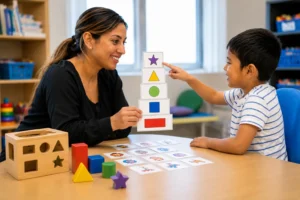
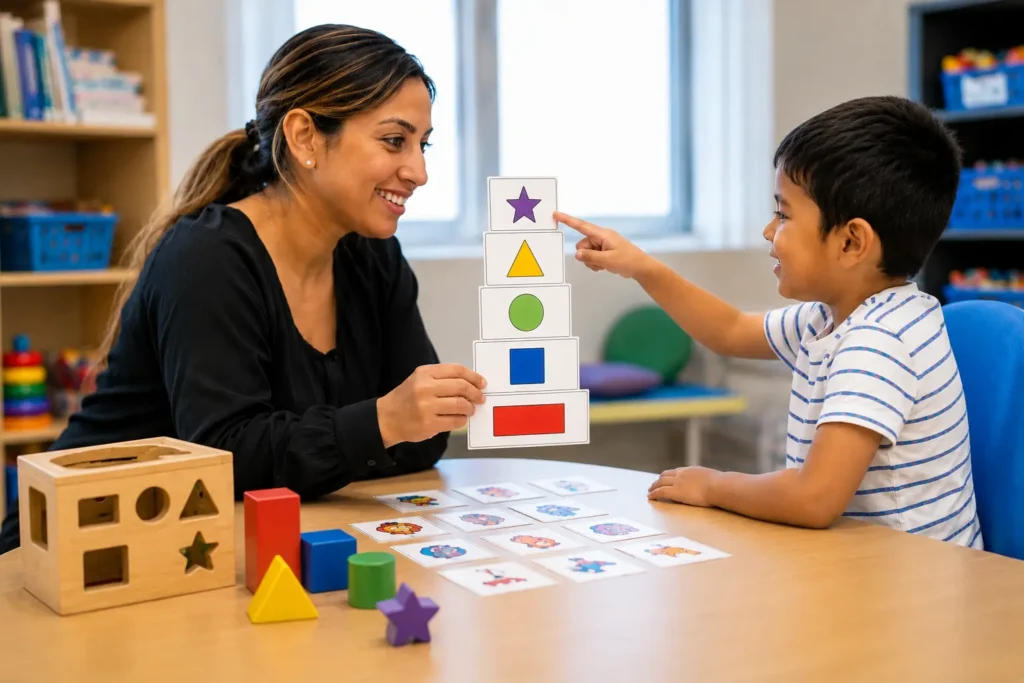
We taught him to hand over a picture card instead. Within three weeks the screaming had dropped by roughly two-thirds, and nobody had done anything to reduce it directly.
(Zayn is a composite of several children; details changed to protect privacy.)
What Skill Acquisition Actually Means
Every ABA programme has two halves. One reduces behaviour that interferes with learning or safety. The other builds new abilities. That second half is skill acquisition.
It covers the domains a child needs to participate in ordinary life:
- Communication: Requesting, labelling, answering, initiating
- Social skills: Turn-taking, joint attention, play with peers
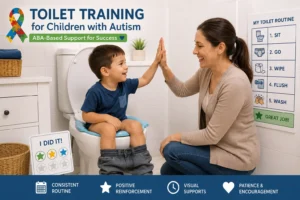
- Daily living: Dressing, toileting, feeding, hygiene
- Academic readiness: Attending, imitating, following instructions
- Self-regulation: waiting, accepting “no”, tolerating change
A quality programme weighs heavily toward this half. If your child’s plan is mostly a list of behaviours to eliminate, that is worth questioning.
Why It Matters More Than Behaviour Reduction
This is the part parents rarely hear explained properly.
In 1985, Carr and Durand ran a study that reshaped the field. They identified when challenging behaviour was most likely , low adult attention, or tasks that were too hard , then taught the children to request attention or help verbally instead.
Teaching that single communicative skill produced replicable suppression of aggression, tantrums, and self-injury across all four children. Nothing was done to punish the behaviour. The behaviour simply became unnecessary.
That approach, functional communication training, has four decades of evidence behind it now. It is the clearest demonstration of why skill acquisition sits at the centre of good practice: behaviour that serves a purpose disappears when a better route to that purpose exists.
Zayn’s screaming didn’t need to be stopped. It needed to be made obsolete.
How a Skill Actually Gets Built
1. Assessment and baseline. Before teaching anything, a BCBA establishes what the child can already do. Standardised tools map the current repertoire; direct observation confirms it.
2. Task analysis. Complex skills get broken into teachable components. Handwashing isn’t one skill , it’s eight or nine, each taught and linked in sequence.
3. Prompting. The child is helped to respond correctly from the start. Errorless approaches deliberately prevent mistakes rather than letting a child guess wrong repeatedly, because errors practised are errors learned.
4. Prompt fading. This is where programmes succeed or fail. Support is systematically withdrawn, from physical guidance, to gesture, to a brief pause, until the child responds independently. A child who only performs a skill with an adult beside them hasn’t acquired it yet.
5. Reinforcement. Immediate, meaningful, and specific to the child. What functions as a reinforcer is determined by observation, not assumption.
6. Mastery criteria. A skill isn’t “learned” because it happened once. Typical criteria require a set accuracy level across multiple sessions, multiple days, and often multiple people.
7. Generalisation and maintenance. The final and most-skipped step, covered below.
Every stage runs on measurement. Our guide to data collection in autism therapy explains how progress is recorded and why it drives every decision in the plan.
The Two Teaching Formats — and Why You Need Both
Discrete Trial Training (DTT) is structured and repetitive: clear instruction, response, immediate consequence, repeat. It’s efficient for building foundational skills that need many practice opportunities in a short window.
Natural Environment Teaching (NET) embeds instruction into play and daily routines, following the child’s motivation. You teach “open” at the actual door the child wants opened.
The research favours combining them. A systematic review comparing the two found NET produced more generalised skill acquisition, and a study of 142 toddlers aged 16–35 months found children receiving NET, or NET combined with DTT, showed greater gains in adaptive behaviour than DTT alone.
DTT builds the skill. NET makes it usable.
Generalisation Is Not Automatic
In 1977, Stokes and Baer published a paper arguing that generalisation had been treated as something you hope for rather than something you engineer. Nearly fifty years later, it remains the most common weakness in real programmes.
A child who labels “cup” with one therapist, at one table, using one cup, has learned something narrow. Skills must be taught across people, settings, and materials deliberately.
This is the practical case for teaching where life actually happens. In-home ABA therapy services in Canada build skills in the kitchen and bathroom where they’ll be used. ABA therapy at daycare in Canada adds peers, noise, and unpredictability — the conditions a skill has to survive. And virtual autism therapy brings a third set of conditions while coaching parents in real time.
Families across the GTA work with us through ABA therapy in Toronto and ABA therapy at home in Mississauga, where the same BCBA oversees goals across every setting so skills transfer rather than stalling in one room.
What Good Skill Acquisition Looks Like
Ask these questions about any programme:
- Are goals functional, does this skill improve my child’s actual day?
- Is there a written generalisation plan, not just an acquisition target?
- Are mastery criteria defined in advance and shared with me?
- Is there a maintenance schedule so mastered skills get revisited?
- Am I being taught the strategies, not just updated on them?
If a provider can’t answer these clearly, that’s useful information.
Frequently Asked Questions
What is the difference between skill acquisition and behaviour reduction?
Skill acquisition teaches new abilities; behaviour reduction decreases interfering behaviour. They work together teaching a replacement skill is usually the most effective reduction strategy available.
How long does it take to acquire a new skill?
It varies enormously by skill complexity, the child’s existing repertoire, and how consistently the programme runs. Simple requests may take days; multi-step self-care routines take months.
What are examples of skill acquisition goals?
Requesting a preferred item, imitating an action, waiting thirty seconds, washing hands independently, responding to a peer’s greeting, or tolerating a change in routine.
Why does my child use a skill in therapy but not at home?
That’s a generalisation gap, and it’s common. The skill needs to be taught deliberately across different people, settings, and materials rather than assumed to transfer.
Who decides which skills to target?
A certified BCBA, using assessment data and critically your family’s priorities. Goals should reflect what would genuinely change your daily life.