ABA therapy activities that affect most at home aren’t separate sessions — they’re the routines you already have, used deliberately. Snack time, bath time, and getting dressed each contain a dozen teaching moments. Short, frequent, embedded practice beats a long daily drill almost every time.
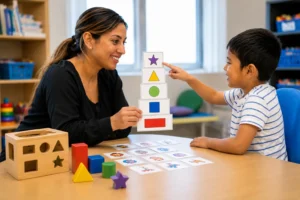
The Flashcards on the Kitchen Table
Maryam was doing everything right, and it was destroying her evenings.
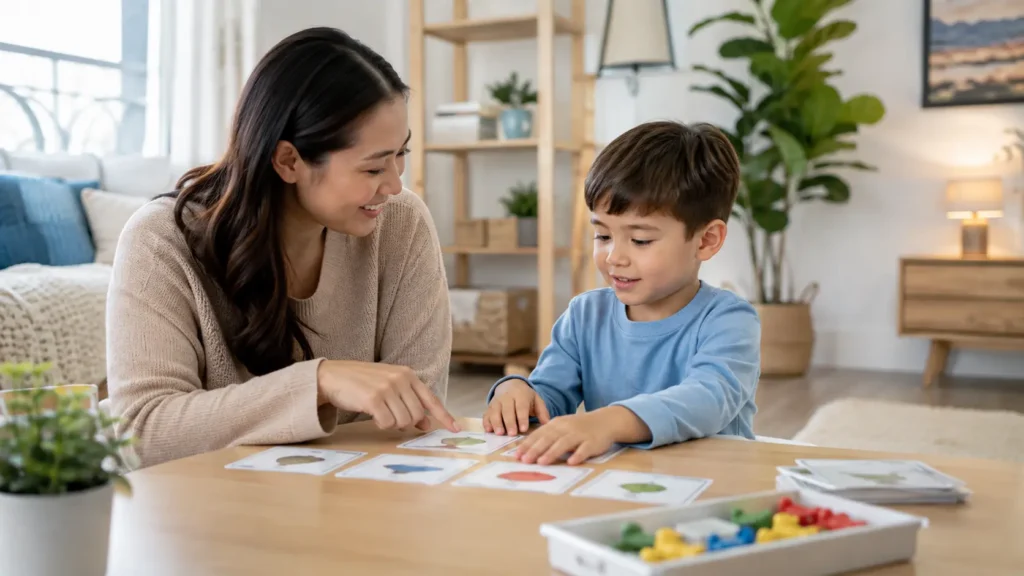
Forty-five minutes a night at the kitchen table with flashcards, after work, after dinner. Her son Idris would last about six minutes before sliding off the chair. She’d coax him back. He’d protest. Nobody enjoyed it, and eight weeks in, nothing had changed.
I asked her to stop entirely.
Instead, at snack time, hold the biscuit box where he can see it and wait. Say nothing. When he reaches or vocalises, name it once — “biscuit” — and hand it over immediately.
Four seconds. Maybe fifteen times a day, across snacks and drinks and toys.
Within a month Idris was requesting six different items. Maryam had got her evenings back.
(Maryam and Idris are composites; details changed to protect privacy.)
Why Home Activities Work
Parent-delivered teaching has a real evidence base. A meta-analysis of parent-implemented interventions concluded they tend to be effective for children with autism across a wide variety of circumstances, and involving parents in early support is treated as best practice in major clinical guidelines.
The naturalistic approaches these activities draw from — teaching inside play and daily routines rather than at a table — show moderate effects on cognitive development and social engagement in meta-analytic reviews.
But here is the honest part most articles omit.
A systematic review of parent-delivered naturalistic programmes found that while most studies showed positive effects for at least some children, results were not consistently positive across studies — and although most parents improved their technique, many never reached the fidelity criteria the programmes specified.
The lesson isn’t that home teaching doesn’t work. It’s that how you do it matters more than how much. Which is exactly what coaching is for.
Four Rules Before Any Activity
Follow their motivation, not your lesson plan. Teach the word for what your child already wants. Motivation is the engine; without it you’re pushing the car.
Keep it short. Ninety seconds, many times a day. Not forty-five minutes once.
One target at a time. Pick a single skill for the week. Scattering across five goals produces progress on none.
Reinforce instantly. The item, the praise, the tickle — within a second or two of the behaviour you want. Delay breaks the connection.
Activities Built Into Routines You Already Have
Snack and mealtimes — requesting
Put preferred foods in sight but out of reach, or in a container your child can’t open. This is called environmental arrangement, and it manufactures a genuine reason to communicate.
Then wait. Five full seconds of silence feels excruciating and is the most powerful teaching tool most parents never use. Give the child room to initiate before you prompt.
Offer choices: hold up two items and let them pick. Choice-making is a skill in itself.
Bath time — body parts, following instructions, sequencing
Bath is a natural chain: undress, in, wash, out, dry, dress. Teach one step at a time, backwards from the end, so the child always finishes the sequence themselves.
Narrate simply as you go — “wash arm”, “wash tummy”. Short, consistent labels teach faster than full sentences.
Getting dressed — independence
Task-analyse it. Socks alone are three steps. Provide only as much help as needed, then systematically provide less. If you’re still doing the whole thing in week six, the prompting never faded.
Laundry and tidying — matching, sorting, joint attention
Sort socks by colour. Hand items back and forth. Match lids to containers. These build the same underlying skills as tabletop programmes, with the advantage of being genuinely useful.
Play — imitation and turn-taking
Copy what your child does with a toy rather than directing them. Contingent imitation is one of the most reliable ways to get an autistic child to notice and attend to you.
Then add one small thing to what they did. They stack two blocks; you stack two and add a third. Expansion, not correction.
Car journeys and walks — labelling and joint attention
Point and name. Keep it to single words for early learners. Follow their gaze rather than redirecting it — teach them the thing they’re already looking at.
Bedtime — receptive language and waiting
Same book, same order, every night. Predictable routines are where language gets learned, because repetition without novelty lets the child focus on the words rather than the situation.
Our guide to ABA therapy techniques for speech and play at home goes deeper on the prompting and reinforcement mechanics behind these.
Four Mistakes That Stall Progress
Testing instead of teaching. “What’s this? What colour? What’s this one?” turns interaction into an exam. Teach, don’t quiz.
Prompting too fast. If you fill every silence, your child never gets the chance to initiate.
Never fading help. Support that stays constant becomes part of the skill. Plan to reduce it from day one.
Turning play into work. If your child starts avoiding an activity they used to enjoy, stop. You’ve made the toy predict demands.
How to Know It’s Actually Working
Count something. Once a week, tally how many times your child independently requests or how many dressing steps they complete alone. Sixty seconds of counting tells you more than a month of impressions.
Progress is rarely linear. A flat week is information, not failure — patterns matter more than any single day.
Where Professional Support Fits
Home activities supplement a programme; they don’t replace one. Research on ABA-based intervention has found greater effects on language from higher-intensity programmes than lower-intensity ones — the hours matter.
If you’re not sure which skills to target, children’s assessments in Canada establish a baseline and identify what to teach next rather than guessing.
In-home ABA therapy services in Canada place a therapist in the rooms where these routines happen, and parent coaching in Canada addresses the fidelity gap the research identifies — watching you run the activity and adjusting in real time is what turns a good idea into a working technique.
Families across the GTA work with us through ABA therapy in Toronto and ABA therapy at home in Mississauga.
Frequently Asked Questions
How much time should I spend on ABA activities at home each day?
Frequency beats duration. Many brief moments spread through the day work better than one long session, and they’re far more sustainable.
Can I do ABA activities without a therapist?
You can use these strategies immediately. But goal selection, prompt fading, and knowing when to change course benefit enormously from a BCBA’s input.
What age are these activities suitable for?
The principles apply across ages; the activities change. Adjust the routine and complexity to your child’s current level, not their birthday.
My child refuses everything I try. What now?
Usually a motivation problem. Start with what they already love, ask for far less than you think you should, and reinforce more generously than feels necessary.
Should I use rewards, or does that create dependence?
Reinforcement is how all learning works. The plan is to fade artificial rewards gradually as natural consequences — getting the biscuit, finishing the game — take over.