
Meltdown in Aisle Seven
It was a busy Saturday at the grocery store. Omar was halfway through his list when the speaker overhead crackled, a cart crashed into a display and a baby started wailing two aisles over.
His five-year-old daughter, Lily, dropped to the floor. She clamped her hands over her ears, squeezed her eyes shut and screamed.
A woman pushing past muttered, “Someone needs a little discipline.”
But Omar knew this wasn’t a tantrum. Lily hadn’t asked for candy. She wasn’t checking whether he was watching. Her body was simply flooded with more noise, light and movement than it could handle. He knelt beside her, shielded her from the stares and waited.
What Lily was going through has a name: sensory overload.
Lily’s story is illustrative, but many Canadian parents have lived a version of it.
What Is Sensory Overload?
Sensory overload happens when the brain receives more input than it can process at once. Sounds, lights, smells, textures and crowds pile up until the nervous system hits its limit and switches into survival mode. It isn’t limited to the five familiar senses, either. Balance, body awareness and internal signals like hunger can add to the load.
Sensory differences are so central to autism that the DSM-5 lists “hyper- or hyporeactivity to sensory input” in its diagnostic criteria. Research estimates that 70% to 90% of autistic people experience sensory differences. In one study that followed autistic children from age 3 to 9, trouble filtering out background noise was the most common, affecting 80% of children by age 9.
In Canada, where about 1 in 50 children and youth have an autism diagnosis, that adds up to many families facing moments like Lily’s.
Signs of Sensory Overload in Children
Overload usually builds before it boils over. Watch for:
- Covering ears or eyes, or squinting
- Pacing, rocking or more stimming than usual
- Irritability, whining or sudden refusals
- Trying to run, hide or escape
- Going very quiet and unresponsive, sometimes called a shutdown
- A meltdown: crying, screaming, dropping to the floor or lashing out
The National Autistic Society calls the early warning phase the “rumble stage.” Spotting it gives you the best chance to step in early.
Is It a Meltdown or a Tantrum?
They can look alike, but they come from very different places.
| Tantrum | Sensory meltdown | |
|---|---|---|
| Cause | Wanting something or avoiding a task | Too much sensory or emotional input |
| Control | Child is in control | Child has temporarily lost control |
| Audience | Often checks if adults are watching | Doesn’t notice who is watching |
| Rewards | Stops once the child gets what they want | Rewards and bribes don’t help |
| How it ends | Fairly quickly once the goal is met | Slowly, after input drops and the body calms |
Common Sensory Triggers
Every child’s sensory profile is unique, but common triggers include:
- Sound: hand dryers, sirens, blenders, crowded gyms
- Sight: fluorescent or flickering lights, busy patterns
- Touch: clothing tags, seams, haircuts, unexpected hugs
- Smell and taste: perfume, cleaning products, mixed food textures
- Movement: escalators, swings, packed hallways
Hidden factors matter too. Hunger, poor sleep, illness and changes in routine all lower a child’s tolerance. Many families picture a cup: each trigger adds a little, and one more drop makes it overflow.
How to Help Your Child
Before: Keep the Cup From Filling
- Preview new places with photos or a short video.
- Visit busy spots at quieter times.
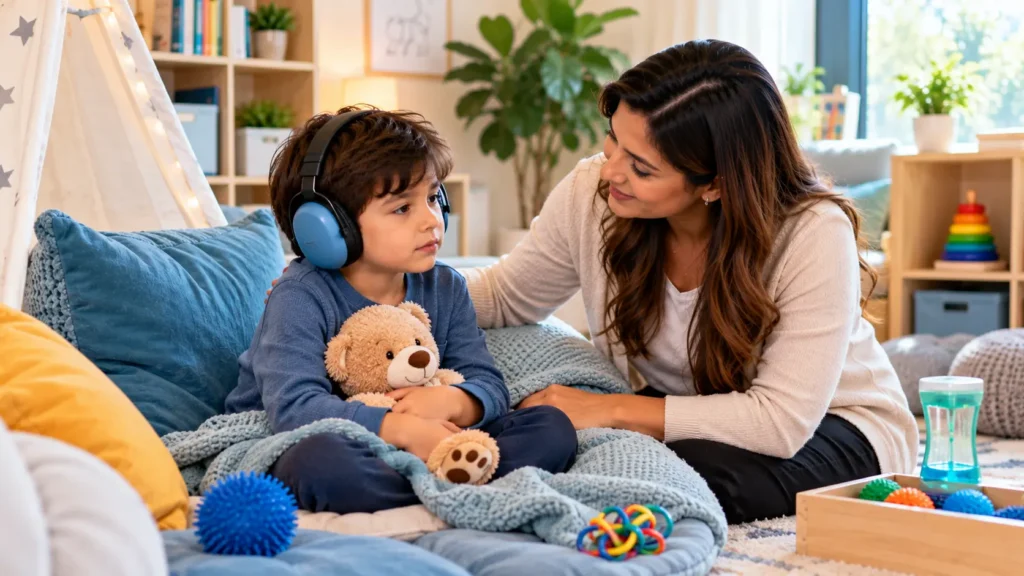
- Pack a sensory kit: noise-reducing headphones, sunglasses, a favourite fidget and a snack.
- Teach a simple “break” signal, like a card or hand sign.
During: Lower the Input
- Move somewhere quieter if you can.
- Use fewer words and a calm, low voice.
- Avoid touch unless your child finds pressure calming or needs help staying safe.
- Wait. Reasoning and consequences won’t land until the storm passes.
After: Rest and Reconnect
Give your child quiet time to recover, and skip the lecture. If they shut down, stay close and let them return at their own pace. Later, jot down what happened before the overload. Patterns become your best prevention plan.
How ABA Therapy Can Help
Sensory differences aren’t something to “fix,” but children can learn skills that make hard moments easier. A Board Certified Behavior Analyst (BCBA) tracks what triggers overload, then teaches practical tools: asking for a break, wearing headphones, following a visual schedule and slowly building comfort with tough situations like haircuts. Many families also work with an occupational therapist, and the two can plan together.
- ABA therapy at home Canada: practise calming routines where your child feels safest, with parents learning each step.
- ABA therapy at daycare: support during noisy circle times, transitions and group play.
- ABA therapy in Toronto: in-home, daycare and virtual options for families across the GTA.
When to Ask for Support
Talk to your doctor or a qualified therapist if overload happens often, keeps your child from daily activities like meals, haircuts or daycare, or leads to unsafe behaviour. A BCBA-led children’s assessment can map your child’s triggers and build a plan.
Today, Omar and Lily shop on Tuesday mornings. Lily wears her headphones, holds a picture shopping list and taps a small “break” card when the store gets loud. Last week, she made it all the way to the checkout and proudly handed over the money herself.
Same store. Same girl. A different plan.
Ready to build your child’s plan? Book a free consultation with our team.
Frequently Asked Questions
What does sensory overload feel like for a child?
Many autistic people describe it as everything being too loud, too bright and too close at once, with no way to turn the volume down. Young children may not have words for it, so it often shows up as behaviour.
Is sensory overload only part of autism?
No. It can also happen with ADHD, anxiety and other conditions, and anyone can feel overloaded at times. It tends to be more frequent and intense for autistic children.
How long does a sensory meltdown last?
It varies from a few minutes to much longer. Recovery often takes longer than the meltdown itself, so plan for quiet time afterward.
Do noise-cancelling headphones help?
Many children find them helpful in loud places like stores, gyms and fireworks shows. A BCBA or occupational therapist can help you decide when to use them.
Will my child outgrow sensory overload?
Sensory differences often continue, but with support many children learn skills that make overload less frequent and easier to manage.
Can ABA therapy help with sensory issues?
Yes. ABA can teach coping and communication skills, like asking for a break, and works well alongside occupational therapy.