A parent may notice that their child needs more help than other children their age. Perhaps simple conversations are difficult, transitions often lead to distress, or everyday routines require considerable support.
Then comes an autism evaluation, followed by a phrase many parents have questions about: Level 2 autism.
What does it actually mean?
Level 2 autism refers to Autism Spectrum Disorder (ASD) requiring substantial support. It does not describe a child’s intelligence, personality, or future potential. Instead, it describes the level of support they may need with social communication and restricted or repetitive behaviours.
Every child is different, and the right support should always be based on the individual—not simply the level assigned to the diagnosis.
What Is Level 2 Autism?
The DSM-5 uses three support levels for autism:
- Level 1: Requiring support
- Level 2: Requiring substantial support
- Level 3: Requiring very substantial support
A child with Level 2 autism may experience noticeable difficulties with communication, social interaction, flexibility, and managing everyday situations.
For example, a child may speak using sentences but struggle to maintain a conversation. Another child may communicate mostly through short phrases, gestures, or other communication methods.
The important point is that Level 2 does not look exactly the same in every child.
Common Signs of Level 2 Autism
Parents may notice several characteristics across different areas of development.
Social Communication
A child may:
- Have difficulty starting or maintaining conversations
- Struggle to understand social cues
- Find back-and-forth interaction challenging
- Have difficulty making or maintaining friendships
- Need support expressing wants, needs, or emotions
- Find changes in communication situations difficult
Repetitive Behaviours and Routines
Some children may:
- Repeat words, phrases, or movements
- Become distressed when routines change
- Develop strong interests in particular subjects or objects
- Prefer predictable activities
- Have difficulty moving from one activity to another
Sensory Differences
Sensory experiences can also affect daily life.
A child might be particularly sensitive to:
- Loud sounds
- Bright lights
- Certain textures
- Clothing
- Food textures or smells
- Crowded environments
Other children may actively seek certain sensory experiences, such as movement or pressure.
What Does “Requiring Substantial Support” Mean?
The phrase can sound intimidating to parents.
In practice, it means that a child may need regular and meaningful support to participate successfully in everyday activities.
A child might need help with:
- Communication
- Social interaction
- Following routines
- Managing transitions
- Emotional regulation
- Daily living skills
- Learning new behaviours
- Participating in school or daycare activities
It does not mean that the child cannot learn or become more independent.
In fact, the right support can help children develop practical skills step by step.
A Real-Life Example
Imagine a six-year-old named Daniel.
Every morning, Daniel follows the same routine. He gets dressed, eats breakfast, and watches his favourite show before school.
One morning, his parents need to leave earlier.
When they tell Daniel that the routine has changed, he becomes upset. He cries, refuses to get dressed, and cannot explain what is wrong.
Instead of simply viewing the behaviour as non-compliance, a therapist may look deeper.
Perhaps Daniel needs:
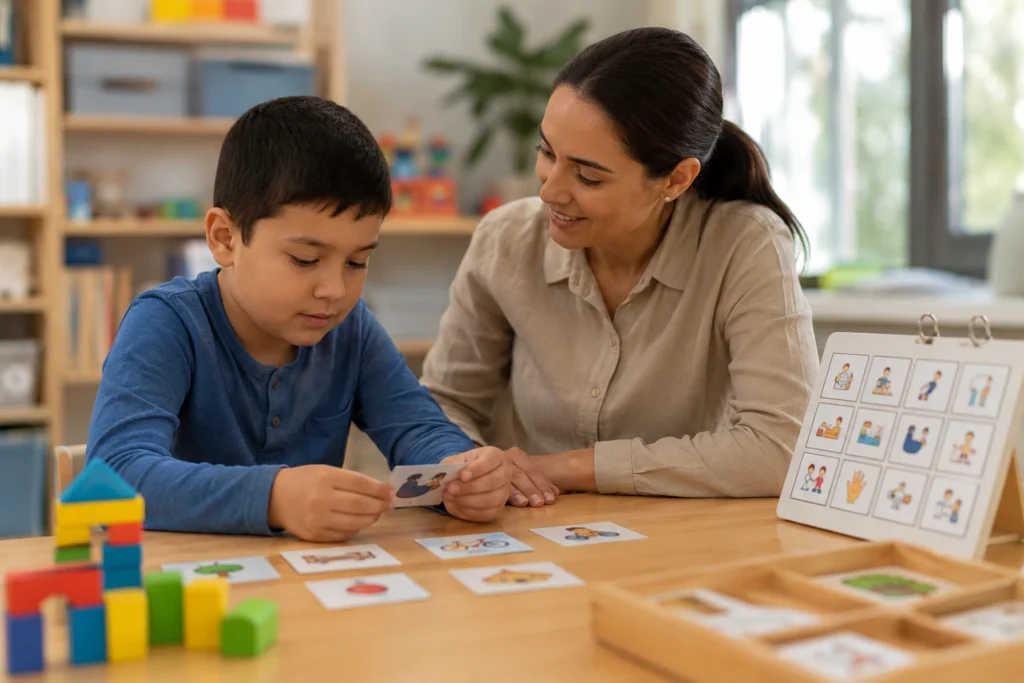
- A visual schedule
- Advance warnings about changes
- A “first-then” statement
- A way to request help
- Practice with flexible routines
Over time, Daniel can learn strategies that make unexpected changes easier to manage.
This is why individualized support matters.
How Can ABA Therapy Support a Child With Level 2 Autism?
Applied Behaviour Analysis (ABA) can help children develop communication, social, and daily-living skills by breaking larger skills into smaller, achievable steps. At Advance Therapy, programs are individualized and designed and supervised by certified BCBAs, with trained ABA therapists delivering sessions.
For families looking for flexible support, ABA therapy at home in Canada allows children to practise skills in their familiar environment. Home sessions can target communication, play, routines, independence, and other practical skills that naturally occur during family life.
ABA Goals May Include:
- Requesting wants and needs
- Developing functional communication
- Following instructions
- Improving social interaction
- Learning daily living skills
- Managing transitions
- Increasing independence
- Reducing behaviours that interfere with learning
The specific goals should depend on the child’s assessment and family priorities.
ABA Therapy in Mississauga
For families living locally, ABA therapy at home in Mississauga provides one-on-one support within the child’s everyday environment. Advance Therapy’s Mississauga service focuses on helping skills such as communication, play, mealtime routines, and transitions transfer into daily life.
This can be particularly helpful when a child finds unfamiliar environments overwhelming.
ABA Therapy in Brampton
Children do not always learn best in a clinical setting.
With ABA therapy at home in Brampton, therapy takes place within the child’s familiar surroundings. Advance Therapy describes its Brampton programs as individualized, BCBA-designed and supervised, with sessions planned around family routines.
This gives therapists opportunities to work on skills where they naturally occur—during play, meals, transitions, sibling interactions, and other everyday activities.
Support Doesn’t Have to Stop at Home
Children also need opportunities to use their skills around other children.
ABA therapy at daycare in Canada can help incorporate support into the child’s existing daycare routine. This can provide opportunities to practise communication, social interaction, play, following routines, and participation alongside peers. Advance Therapy offers daycare-based support as part of its broader ABA services.
What Can Parents Do at Home?
Parents can support skill development through everyday routines.
Try to:
- Use simple, clear language
- Give your child extra processing time
- Break complicated tasks into smaller steps
- Use visual schedules when helpful
- Prepare your child for changes
- Reinforce appropriate communication
- Celebrate small improvements
- Practise skills during natural routines
Most importantly, avoid comparing your child’s progress with another child’s.
Progress may look different for every child.
Why Individualized Assessment Matters
A diagnosis level is only one part of understanding a child.
Two children with Level 2 autism can have very different strengths and support needs. One may need more help with communication, while another may have stronger language skills but significant difficulty with sensory regulation or flexibility.
That is why a comprehensive assessment is important before setting therapy goals. Advance Therapy’s process includes a comprehensive assessment of the child’s strengths and needs before developing an individualized program.
Frequently Asked Questions
Is Level 2 autism considered severe autism?
Level 2 means the person requires substantial support, but the term does not determine a person’s abilities or future. Autism presents differently from one individual to another.
Can a child with Level 2 autism become independent?
Many autistic children develop greater independence over time with appropriate education, therapy, communication support, and opportunities to practise skills. Progress varies considerably between individuals.
Does Level 2 autism mean a child cannot speak?
No. Some children with Level 2 autism use sentences and have considerable verbal language, while others may use fewer words or alternative communication methods.
Can ABA therapy help children with Level 2 autism?
ABA can support individualized goals such as communication, social interaction, daily living, learning, and independence. Programs should be based on the child’s assessment and supervised by appropriately qualified professionals.
Does the autism level stay the same forever?
Not necessarily. Support needs can change as a child develops new skills, their environment changes, or their circumstances change. The level should not be treated as a fixed prediction of the future.
Final Thoughts
Hearing “Level 2 autism” can feel overwhelming at first.
But a diagnosis level is not a limit on your child’s potential.
It is simply information that can help families and professionals understand where additional support may be needed.
The most meaningful progress often happens through small steps: a child asking for help instead of becoming frustrated, joining a game with another child, completing part of a daily routine independently, or coping with a change that once felt impossible.
With individualized goals, consistent support, and a team that understands the child’s strengths, those small steps can become important milestones.