
Quick answer: Yes. Roughly 40% of autistic children meet criteria for an anxiety disorder, and separation anxiety disorder appears in about 9%, several times the general-population rate. In autism it is usually driven less by fear of losing a parent than by intolerance of uncertainty: not knowing what happens next.
Eleven Minutes at the Daycare Door
His mother called him a “velcro kid.”
Rehan was four. Every weekday morning at the daycare door, the same sequence: the grip on her sleeve, the sound that started low and climbed, eleven minutes of it by her stopwatch.
Staff told her he settled within two minutes of her leaving. She didn’t believe them.
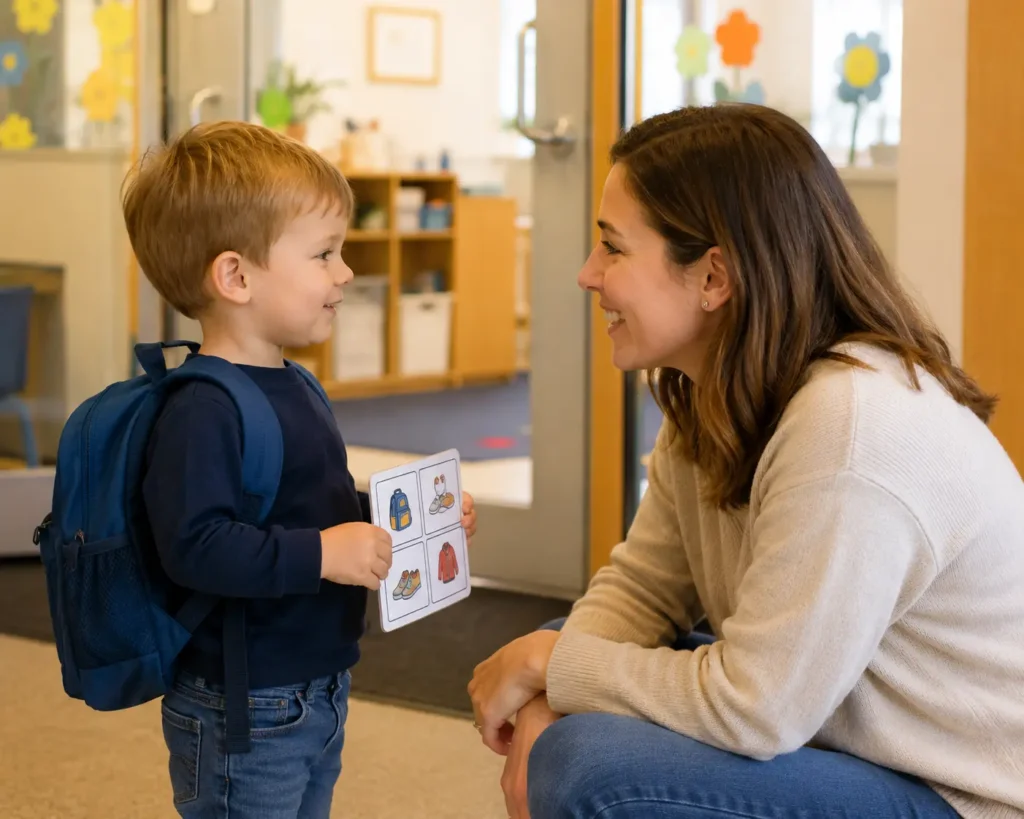
What changed things wasn’t a longer goodbye or firmer reassurance. It was a laminated card with four pictures: a bag on hook, snack, circle time, Mum came back.
Within three weeks, eleven minutes became ninety seconds.
(Rehan is a composite of several children; details changed to protect privacy.)
Is Separation Anxiety Common in Autism? The Actual Numbers
Anxiety is one of the most common co-occurring conditions in autism. The most widely cited meta-analysis of children and adolescents under 18 found roughly 40% met criteria for at least one anxiety disorder.
Within that, the breakdown matters:
- Specific phobia about 30%
- OCD about 17%
- Social anxiety about 17%
- Generalised anxiety about 15%
- Separation anxiety disorder about 9%
- Panic disorder can about 2%
So it is common but not the most common presentation. Knowing that helps you look for what is actually driving your child’s distress.
Two caveats most articles omit. A further 30–40% of autistic children experience subclinical anxiety: below diagnostic threshold, still disrupting daily life. And standard anxiety questionnaires were validated on non-autistic children, so they frequently miss autistic presentations. That 9% is likely an undercount.
What Separation Anxiety Looks Like in an Autistic Child
It often doesn’t match the textbook image of a clinging, tearful toddler.
Signs to watch for:
- Distress building in the lead-up to a departure, not only at the moment itself
- Increased stimming, rocking, flapping, pacing as separation approaches
- School or daycare refusal, sometimes presenting as stomach aches or headaches
- Meltdowns at drop-off, or the opposite: shutdown, silence, unresponsiveness
- Regression in mastered skills, including toileting or independent sleep
- Night waking, or refusing to sleep alone
- Repetitive questioning about when you’ll return, sometimes dozens of times
Anticipation is the signature. Separation anxiety builds before the event and eases after reunion.
Or Is It Something Else? Three Look-Alikes
This distinction changes the entire support plan, and it’s where families most often go wrong.
Sensory overload is triggered by input such as noise, lights, crowds and not by who is present. A child overwhelmed at drop-off may be reacting to twenty-five loud children, not to you leaving.
Transition difficulty attaches to the change of activity, not the person. If your child struggles just as much moving from bath to bed with you standing right there, the goodbye may not be the real problem.
Separation anxiety follows a person-specific, predictable pattern: escalating before you go, settling after you return, and improving when the child receives reliable information about timing.
Keep a two-week log of what precedes each episode. It is the single most useful thing you can bring to a clinician.
Why It Happens
Intolerance of uncertainty. This is the mechanism the research keeps returning to. Intolerance of uncertainty describes a tendency to react strongly and negatively to unpredictable situations, and studies support a model in which it mediates the relationship between autism and anxiety. Meaning it may largely explain why anxiety rates run so high in autistic children.
Applied to a goodbye, the fear often isn’t “you might not come back.” It’s “I have no information about what happens between now and when you do.”
That reframe changes how you intervene: reassurance addresses the wrong fear, information addresses the right one.
Sensory sensitivity. Uncertainty and sensory over-responsivity are closely linked, in one study they together explained roughly half the variance in autistic children’s sensory sensitivities. A child already near sensory capacity has no reserve left for a hard transition.
Communication differences. A child who cannot yet say “I don’t know where you’re going” says it behaviourally instead.
Preference for sameness. Routine reduces uncertainty. A departure disrupts the routine and removing the coping strategy at the exact moment the stress arrives.
Support Strategies That Actually Work
Build predictability before anything else. Visual schedules, first-then boards, and a fixed drop-off sequence do more than reassurance ever will. Rehan’s four-picture card worked because it converted an unknown stretch of time into a known one that ended with Mum comes back.
Use graduated exposure, not immersion. Short separations first, extending as tolerance grows. Exposure is the component of anxiety treatment most consistently linked to rapid improvement in autistic youth but it works in steps, not leaps.
Never sneak out. It buys one easier morning and teaches your child that your presence is unreliable, raising baseline vigilance for weeks afterward. Say goodbye the same way every time, then go.
Keep the goodbye short and identical. Same words, same length, same order. Ritual is a form of information.
Adapt the therapy. Standard CBT protocols underperform with autistic children unless modified and with more visual material, more concrete and literal language, slower pacing through exposure steps.
Coordinate across settings. The same visual, the same phrase, the same sequence everywhere. Consistency is the active ingredient, which is why ABA therapy at daycare in Canada is often paired with ABA therapy at home in Canada: the goodbye is practised where it actually happens, then reinforced where the child feels safest.
Put the strategies in parents’ hands. Parent-mediated programmes targeting intolerance of uncertainty have shown clinical improvement in randomised trials. The person present at every transition is the one who needs the tools. Our guide to ABA therapy techniques for speech and play at home covers complementary approaches between sessions.
When to Seek Professional Support
Consider a formal assessment if distress persists beyond a few weeks despite consistent routines, prevents school or daycare attendance, triggers self-injury, or coincides with loss of previously mastered skills.
Separation anxiety rarely resolves with age alone. Left unaddressed, it narrows a child’s world, fewer settings, fewer people, less independence and that narrowing compounds year on year.
This is the practical case for early intervention services in Canada. The younger a child is when predictability and graduated exposure become an ordinary part of their day, the less time anxiety has had to shape what they are willing to attempt.
Frequently Asked Questions
Is separation anxiety a symptom of autism? No. It is a co-occurring anxiety condition, not a core autistic trait. Autism involves social communication differences and restricted or repetitive behaviours; separation anxiety is diagnosed separately.
At what age should separation anxiety stop? Some separation distress is developmentally typical up to around age three. Beyond that, if it is intense, persistent, and interfering with daily functioning, it warrants assessment.
How do I tell a meltdown from separation anxiety? Check the trigger and the timing. Meltdowns follow sensory or cognitive overload and can occur anywhere. Separation anxiety escalates predictably before a departure and eases after reunion.
Can ABA therapy help with separation anxiety? It can, where the focus is graduated exposure, functional communication, and predictability rather than pushing a child through distress. Ask any provider directly how they respond when a child escalates.
Does separation anxiety mean my child is insecurely attached? No. Autistic children can be securely attached and still find separations very hard, because the difficulty usually lies in uncertainty and transition rather than in the relationship.