Quick answer: ABA therapy techniques are structured teaching methods built on the science of Applied Behaviour Analysis. The most widely used ones include positive reinforcement, discrete trial training (DTT), natural environment teaching (NET), prompting and prompt fading, shaping, chaining, functional communication training (FCT), and token economies. A Board Certified Behavior Analyst (BCBA) chooses which techniques to use based on your child’s assessment — no two programs should look the same.
If your child has recently been diagnosed with autism spectrum disorder, you have probably already met a wall of acronyms. DTT. NET. FCT. Mands and tacts. It can feel like you need a degree just to understand what happens in your child’s therapy session.
You don’t. Every one of these ABA therapy techniques comes down to the same simple idea: figure out why a behaviour happens, break a skill into small steps, teach those steps in a way that motivates your child, and measure whether it’s working.
This guide walks through the techniques your child’s team is most likely to use — what each one looks like in real life, what it’s good for, and which ones you can start using at home this week.
What Is ABA Therapy, in Plain Language?
Applied Behaviour Analysis is the study of how behaviour is shaped by what happens right before it and right after it. Applied to autism, it becomes a set of teaching strategies for building communication, social, play, and daily-living skills — and for reducing behaviours that get in the way of a child’s day.
It is the most researched intervention for autism. The National Clearinghouse on Autism Evidence and Practice reviewed nearly a thousand studies and identified 28 focused intervention practices that met the criteria for evidence-based practice — a large share of which come directly from behaviour analysis.
That matters in Canada, where the 2019 Canadian Health Survey on Children and Youth found that 1 in 50 Canadian children and youth aged 1 to 17 had a diagnosis of ASD. If you want to see how ABA compares to the other model Ontario families often hear about, our guide to IBI vs ABA therapy in Ontario breaks down the differences.
The Foundation Behind Every ABA Technique: The A-B-C Model
Before the specific techniques make sense, you need one concept: antecedent → behaviour → consequence.
- Antecedent — what happened right before (a request, a noise, a transition)
- Behaviour — what your child did
- Consequence — what happened right after
Behaviour analysts collect ABC data to find the function of a behaviour. A child who screams at the dinner table might be escaping a food they dislike, or asking for attention, or requesting something they can’t yet name. Those are three completely different problems — and they need three completely different plans.
This is why a proper children’s assessment comes before any technique is selected. Skipping it is like prescribing medication without a diagnosis.
The other constant is positive reinforcement. When a behaviour is followed by something the child genuinely values, that behaviour becomes more likely. The key word is genuinely — reinforcers are identified through preference assessments, not assumed. For one child it’s bubbles. For another it’s a few minutes of a favourite song.
Core ABA Therapy Techniques for Autism
1. Discrete Trial Training (DTT)
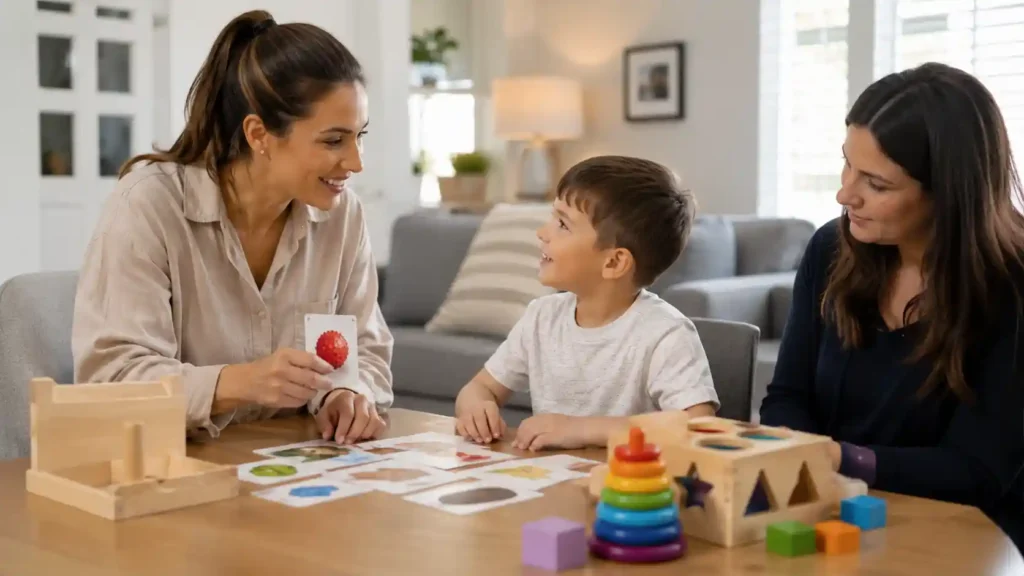
The most structured technique in the toolkit. A skill is broken into its smallest teachable unit and taught in short, repeated trials: instruction → child’s response → immediate feedback → brief pause.
Best for: early foundational skills — matching, imitation, first words, colours, following one-step directions. Looks like: “Touch red.” Child touches red. “Yes! Nice job.” High-five and a moment with a preferred toy.
2. Natural Environment Teaching (NET)
The same learning principles, moved into play and daily routines. Instead of a table, the teaching happens on the living room floor, in the bath, or at the grocery store.
Best for: generalization — making sure a skill learned in therapy shows up in real life. Looks like: Your child reaches for the bubbles. The therapist waits, holds the jar just out of reach, and gives it the moment your child signs or says “bubbles.”
3. Pivotal Response Treatment (PRT)
A play-based, child-led approach that targets “pivotal” areas — motivation, responding to multiple cues, self-management, and initiating social interaction — on the theory that improving these creates ripple effects across many other skills.
Best for: children who have skills but don’t use them spontaneously.
4. Task Analysis and Chaining
A multi-step routine is broken into an ordered list of steps, then taught link by link. Forward chaining teaches step one first; backward chaining teaches the last step first so the child always finishes with a success.
Best for: handwashing, dressing, tooth brushing, packing a backpack.
5. Shaping
Reinforcing successive approximations of a target skill. A child working toward “water” might first be reinforced for any sound, then “wa,” then “wawa,” then the full word.
Best for: skills that are too far away to teach all at once.
6. Prompting and Prompt Fading
Prompts are the help you give: physical guidance, a gesture, a model, a verbal cue, a visual support. The critical half of this technique is fading — systematically reducing that help so your child doesn’t become prompt-dependent.
Errorless learning is a related strategy: prompt immediately so the child gets it right the first time, then fade. It reduces frustration for children who shut down after mistakes.
7. Modeling and Video Modeling
Demonstrating the skill, live or on video, for the child to imitate. Video modeling works especially well for social sequences — greeting a peer, joining a game, taking turns.
8. Token Economies
Your child earns tokens for target behaviours and exchanges them for a chosen reward. It bridges the gap between doing something hard now and getting something good later — a genuine skill in itself.
9. Functional Communication Training (FCT)
One of the most impactful techniques in modern ABA. Instead of only reducing a challenging behaviour, FCT teaches a communication response that achieves the same result more effectively.
A child who hits to escape a demand is taught to sign or say “break.” The need was always legitimate; FCT gives it a better route.
10. Differential Reinforcement
Reinforcing a desired behaviour while withholding reinforcement for the behaviour you’re reducing — for example, reinforcing every instance of asking for attention appropriately while no longer responding to shouting.
ABA Speech Therapy Techniques: Building Communication
A quick clarification worth making, because search results blur this constantly: “ABA speech therapy” is not the same as speech-language pathology. A Speech-Language Pathologist works on articulation, oral-motor skills, fluency, and language structure. ABA works on the function of communication — teaching a child to use language to get needs met and connect with people. The two disciplines complement each other, and strong programs coordinate between them.
Within ABA, communication is taught through verbal behaviour, B.F. Skinner’s functional analysis of language. Rather than sorting language into nouns and verbs, it sorts it by purpose:
| Verbal operant | What it is | Example |
|---|---|---|
| Mand | Requesting | Saying “juice” because they want juice |
| Tact | Labelling | Seeing a dog and saying “dog” |
| Echoic | Repeating | Therapist says “ball,” child says “ball” |
| Intraverbal | Conversation | Answering “What do you drink from?” with “a cup” |
| Listener responding | Comprehension | Following “get your shoes” |
A child might be able to label over a hundred everyday items but still be unable to ask for those same items when they want them — which is exactly why these are assessed separately.
Techniques used in this area include:
- Mand training — usually taught first, because requesting is immediately reinforcing and reduces frustration-driven behaviour
- Echoic training — building vocal imitation as a foundation for words
- Pairing — becoming associated with good things so your child wants to communicate with you
- AAC and PECS integration — picture exchange systems and speech-generating devices, taught with the same reinforcement principles. Research consistently shows AAC supports rather than suppresses vocal speech
- Time delay — pausing expectantly instead of prompting, creating space for your child to initiate
Assessment tools like the VB-MAPP or ABLLS-R map which of these repertoires are strong and which need work, so teaching starts at the right level. This is a core focus of our early intervention programs, where the developmental window is widest.
ABA Therapy at Home Techniques Parents Can Start Using
Therapy hours matter, but the hours between sessions are where skills either generalize or fade. These are strategies you can use without a clinical background.
1. Catch the behaviour you want. Specific, immediate praise — “You put your cup in the sink, thank you!” — beats vague praise hours later.
2. Use the “first-then” structure. “First shoes, then park.” It’s the Premack principle, and it works because it makes the sequence visible and predictable.
3. Build in choices. Two acceptable options (“blue shirt or green shirt?”) gives your child real control and dramatically reduces refusal.
4. Create communication opportunities. Put a favourite snack in a clear container your child can see but not open. Give a small portion so they have to ask again. Sabotage the routine gently — a puzzle with a missing piece invites a request.
5. Use visual supports. A photo schedule for the morning routine, a timer for transitions, a “wait” card. Many autistic children process visual information more easily than spoken instructions.
6. Wait longer than feels comfortable. Count to five silently after asking a question. Adults fill silence far too fast, and that silence is where your child’s response was going to happen.
7. Keep it short and end on success. Three good minutes beats twenty frustrating ones. Always finish with something your child can do.
8. Track one thing. A tally on the fridge — how many times your child requested independently today — turns a vague impression of progress into evidence.
Parents who apply these consistently see faster generalization than families relying on session hours alone, which is why parent coaching is built into our programs. For families who want techniques taught directly in the environment where they’ll be used, in-home ABA therapy removes the generalization gap entirely — your child learns to brush their teeth in their own bathroom, not a clinic room.
How the Right Techniques Get Chosen for Your Child
A good program does not pick techniques off a list. The sequence is:
- Assessment — a BCBA evaluates skills across communication, social, play, and daily living domains, plus a functional behaviour assessment where challenging behaviour is present
- Goal setting — measurable goals built around what actually matters to your family
- Technique selection — matched to your child’s learning profile, age, and goals
- Continuous data collection — every session generates data
- Adjustment — if the data doesn’t move within a reasonable window, the technique changes
That last point separates quality ABA from everything else. If nobody can show you a graph of your child’s progress, ask why.
What Good ABA Looks Like in 2026
The field has changed meaningfully, and it’s fair to expect a modern provider to reflect that:
- Assent-based practice. Children can decline, take breaks, and signal “no” — and that is respected, not overridden.
- Neurodiversity-informed goals. Goals target skills that expand a child’s independence and access, not the elimination of harmless autistic behaviours like stimming.
- Naturalistic and play-based delivery. Less table time, more real life.
- Family-centred. Parents are collaborators, not observers.
If a program feels like compliance training rather than skill building, that’s worth raising with your BCBA.
ABA Therapy Techniques Across Ontario
These techniques are delivered the same way everywhere, but access and funding logistics differ by city. Advance Therapy provides in-home, daycare, and virtual programs across the country — you can see our full range of ABA therapy services in Canada, including dedicated local support for families seeking ABA therapy in Toronto and ABA therapy in Mississauga.
Families outside major centres, or facing long in-person waitlists, often start with virtual autism therapy, which works particularly well for parent-led techniques.
Frequently Asked Questions
What are the main ABA therapy techniques?
The most commonly used are positive reinforcement, discrete trial training, natural environment teaching, prompting and prompt fading, shaping, task analysis and chaining, modeling, token economies, functional communication training, and differential reinforcement. Most programs blend several at once.
Which ABA technique is best for a nonverbal child?
There is no single best technique, but mand training combined with AAC or PECS is usually where teams start — because giving a child a reliable way to request reduces frustration immediately. Echoic training and pairing typically run alongside it.
Can parents use ABA techniques at home without training?
Yes, for foundational strategies: specific praise, first-then statements, offering choices, visual schedules, and creating communication opportunities. Techniques involving challenging behaviour should be guided by a BCBA, because using them without knowing the behaviour’s function can unintentionally make it worse.
How long before ABA techniques show results?
It varies. Simple skills taught through DTT can show movement in a few weeks. Broader gains in communication and independence generally emerge over months. Your BCBA should be tracking data continuously and adjusting when progress stalls.
Is ABA the same as speech therapy?
No. ABA teaches the function of communication — requesting, labelling, conversing — while a Speech-Language Pathologist addresses articulation, oral-motor skills, and language structure. Many children benefit from both, working toward shared goals.
How many hours of ABA does a child need?
It depends on age, goals, and needs. Comprehensive early intervention programs are typically more intensive, while focused programs targeting specific skills need fewer hours. A BCBA determines this during assessment.
Are ABA therapy techniques covered by funding in Canada?
Funding varies by province — the Ontario Autism Program, FSCD in Alberta, AFU in British Columbia, Jordan’s Principle, and many private insurance plans can all contribute. Our team can walk you through what’s available where you live.
Talk Through the Right Techniques for Your Child
Reading about techniques is a good start. Knowing which ones fit your child takes an assessment.
Advance Therapy’s certified BCBAs and ABA therapists build individualized programs delivered at home, at daycare, or online across Canada. Book a free consultation or call +1 519 771 4679 — we’ll talk through your child’s needs and what a plan could look like.